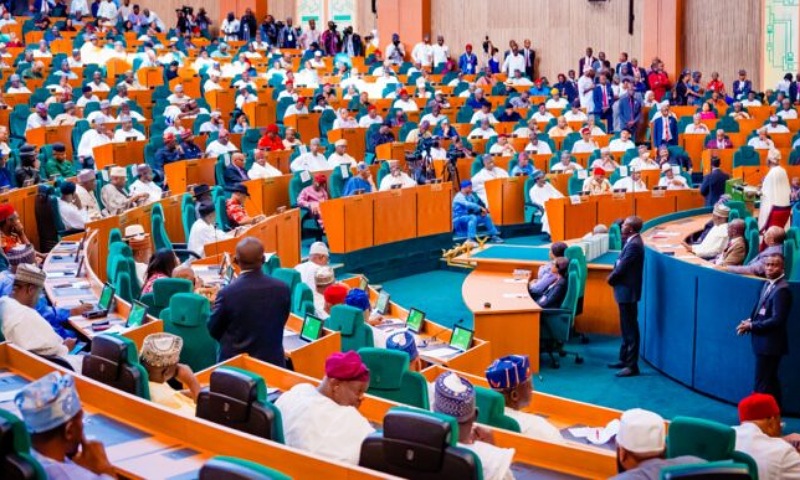
President Bola Tinubu presented the N58.47 trillion 2026 budget to the National Assembly.8 He named it the “Budget of Consolidation, Renewed Resilience and Shared Prosperity.” This happened during a joint session on December 19, 2025.
The House of Representatives passed the budget for second reading. This occurred on January 29, 2026. Lawmakers approved it without debate.
Budget Objectives and Assumptions
The budget focused on macroeconomic stability. It also aimed to strengthen national security. Additionally it sought to expand capital investments.
Key assumptions guided the projections. These included an oil price benchmark of $64.85 per barrel. Oil production stood at 1.84 million barrels per day. The exchange rate stabilized at N1,400 to the dollar.
House Leader’s Address
House Leader Prof. Julius Ihonvbere led the session. He highlighted President Tinubu’s reforms. Ihonvbere noted short-term pains but promised long-term gains.
He stated, “Development that is not sustainable is not development at all.” Moreover he praised economic progress. Growth reached 3.98 percent. Inflation dropped to 14.45 percent from 25 percent. Ihonvbere added,
“We have not printed a single naira since this government came into office.” External reserves hit $47 billion. This covered over 10 months of import.
He emphasized fiscal discipline. “This is a departure from the past where recurrent spending dominated,” Ihonvbere said. Capital expenditure exceeded recurrent costs.
Furthermore he urged support. “We are not saying the government is perfect, but it is our duty, as representatives of 360 constituencies, to guide it to do the right things at all times,” he remarked.
Detailed Budget Breakdown
Total revenue projected at N34.33 trillion. Expenditure totaled N58.18 trillion. This created a deficit of N23.85 trillion. Statutory transfers amounted to N4.09 trillion. Debt servicing reached N15.91 trillion. Non-debt recurrent expenditure stood at N15.25 trillion. Capital expenditure hit N26.08 trillion.
Sectoral Allocations
Security and defence received N5.41 trillion. This addressed insecurity and food challenges. Infrastructure got N3.56 trillion. Education secured N3.54 trillion. Health obtained N2.48 trillion.
Next Legislative Steps
Speaker Tajudeen Abbas put the bill to a vote. Members approved it overwhelmingly. He referred it to the House Committee on Appropriations. This allowed further scrutiny.The House announced a two-week recess. Lawmakers planned to resume on February 17, 2026. They aimed to pass the budget then.
Budget defense sessions followed. Ministries and agencies prepared to present details.This step ensured thorough review. It also promoted transparency in the process.