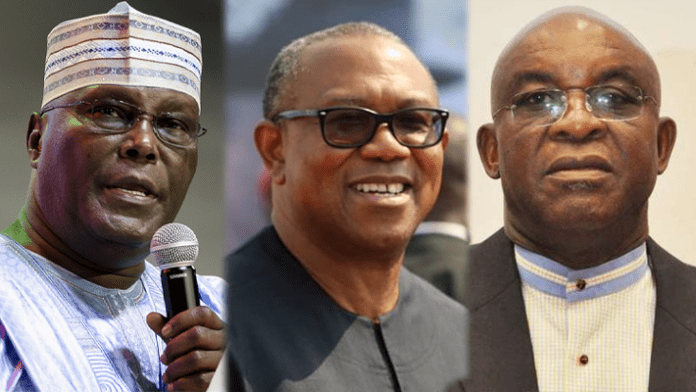
Former Vice President Atiku Abubakar, Labour Party’s 2023 presidential candidate Peter Obi, and PDP elder statesman Bode George have accused President Bola Tinubu of using the Economic and Financial Crimes Commission (EFCC) to weaken opposition parties ahead of future elections.
The opposition leaders made the claim in a joint statement issued on Sunday. In addition, the statement carried the signatures of ADC National Chairman David Mark, former APC National Chairman John Odigie-Oyegun, and Lawal Batagawara. They called for an independent audit of federal, state, and local government accounts covering 2015 to 2025.
According to them, the government now deploys state power against political rivals rather than against economic crimes.
Opposition Links EFCC Actions to Defections
The leaders linked their claims to recent defections to the ruling All Progressives Congress (APC). Notably, they cited the defection of Rivers State Governor Siminalayi Fubara from the PDP.
They alleged that agencies such as the EFCC, the Nigeria Police, and the ICPC now act selectively. Specifically, they claimed that these institutions target opposition figures while sparing ruling party members.
“Across our nation, state power is being deployed not for the prevention of economic crimes, but for the persecution of perceived political adversaries,” the statement said.
As a result, the opposition warned that Nigeria’s multiparty democracy now faces serious risk ahead of the 2027 general election.
Opposition Cites Selective Prosecution
The opposition criticised what it described as selective prosecution by the EFCC. For example, they cited a past remark by former APC National Chairman Adams Oshiomhole, who once said that “once you have joined APC, all your sins are forgiven.”
Therefore, the group proposed reforms. These include embedding anti-corruption officers in government payment systems. They called for an independent review body with full access to public accounts.
Meanwhile, the ADC chapter in Kebbi State criticised the EFCC over the detention of former Attorney-General of the Federation Abubakar Malami (SAN). The party described the action as unconstitutional and politically motivated.
Malami, through his spokesperson Mohammed Bello Doka, denied the allegations. He described them as “false, baseless, and part of a coordinated media trial.”
Presidency Rejects Allegations
However, the Presidency rejected the accusations. In a statement signed by Bayo Onanuga, Special Adviser on Information and Strategy, the Presidency described the claims as scapegoating.
Onanuga said politicians were joining the APC voluntarily. Accordingly, he dismissed claims of coercion or intimidation. He also reaffirmed the EFCC’s independence, stressing that it operates without presidential interference.
“The EFCC is an independent institution established by law,” he said. He noted that courts, not the presidency, decide prosecutions.
Read also: EFCC Explains Malami Arrest, Says 5 Bail Conditions Unmet