
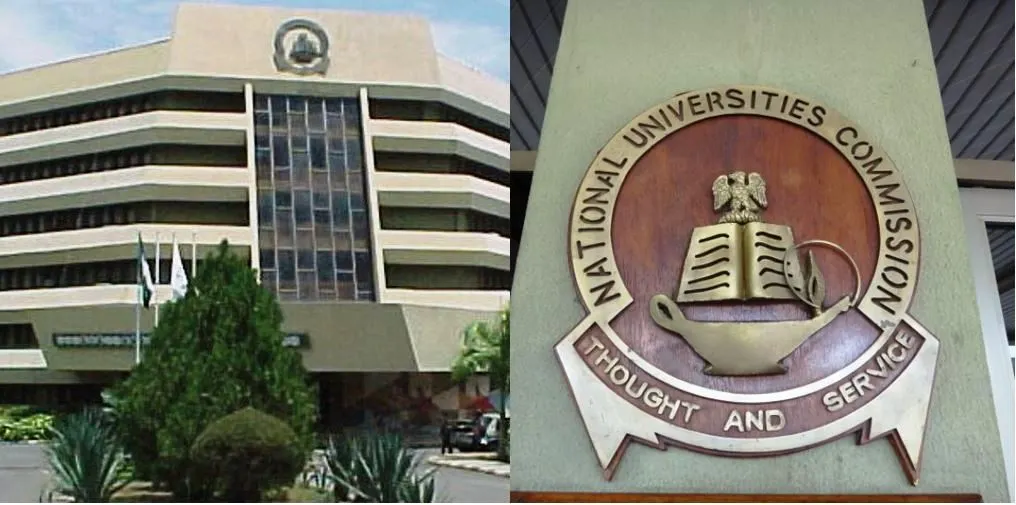
The National Universities Commission (NUC) has barred recipients of honorary doctorate degrees from using the “Dr.” title as a prefix to their names.
In a public notice issued on Thursday, the commission warned that it will sanction institutions that breach the new guidelines. It also warned individuals who misuse honorary titles.
The directive forms part of the newly approved “Guidelines for the Award and Use of Honorary Doctorate Degrees in Nigeria.”
The commission said it introduced the guidelines to curb the indiscriminate conferment and misuse of honorary awards.
‘Honorary Degrees Not Equivalent to Earned Doctorates’
Acting under its statutory powers in line with the Education Act (National Minimum Standards and Establishment of Institutions), CAP E3, Laws of the Federation of Nigeria, 2004, the commission noted that honorary doctorates are ceremonial distinctions. They are not equivalent to earned academic doctorates.
“The general public is further reminded that honorary doctorate degrees, whether awarded by institutions within Nigeria or abroad, are honorary distinctions and should not be represented or regarded as equivalent to earned academic doctorate qualifications,” the statement said.
The commission allowed recipients to use the approved nomenclature of their awards. Examples include Doctor of Science (Honoris Causa), D.Sc. (h.c.), and Doctor of Letters (Honoris Causa), D.Litt. (h.c.). They may place these after their names.
However, the NUC prohibited them from using “Dr.” as a prefix. It reserved the title for holders of earned doctoral degrees and medical professionals.
It also barred honorary degree holders from using the award to practise as scholars or professionals. They cannot supervise research or head academic units.
Stricter Rules for Universities
The NUC tightened the rules guiding universities that confer honorary doctorates.
Only approved public and private universities may grant honorary doctorate degrees. In addition, only institutions that have graduated their first set of PhD students qualify to confer such awards.
The commission capped the number of honorary degrees at three per convocation.
It directed universities to include the designation “Honoris Causa” in all awards. Institutions must confer the awards in person. They may conduct virtual or posthumous conferment only in exceptional cases.
The NUC also banned the collection of fees for honorary doctorates. Universities must not demand or expect payment from recipients.
Exclusion of Serving Public Officials
The guidelines exclude self-nominated candidates. They also disqualify serving elected or appointed public officials.
Universities must publish the names of recipients on their official websites. They must also make their selection procedures public.
All nominations must pass through statutory committees. The university senate and governing council must approve them.
The NUC directed universities to provide written and verbal orientation to recipients on how to use the award properly.
It also ordered institutions to establish clear revocation policies. Universities must withdraw awards from recipients convicted of fraud or found guilty of unethical conduct.
Warning of Sanctions
The commission said the measures align with the Keffi Declaration of 2012. It added that the guidelines aim to protect the integrity and global reputation of the Nigerian university system.
The NUC warned that it will sanction any institution or individual that violates the rules.
“Appropriate regulatory sanctions shall be imposed on any institution found to have violated the NUC-approved guidelines, as well as on individuals who misuse honorary titles,” the commission said.
The commission urged all stakeholders to comply fully with the new procedures governing honorary doctorate degrees in Nigeria.