
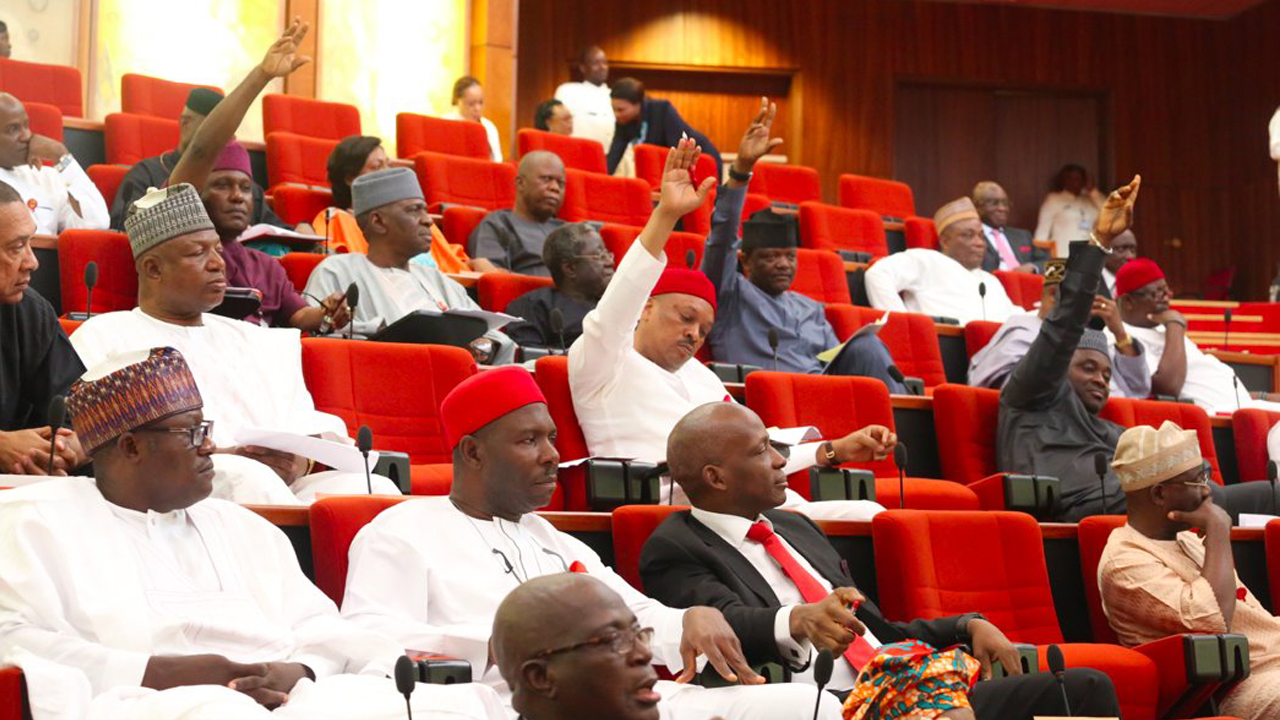
The Senate on Wednesday passed the Electoral Act Amendment Bill after a five-hour clause-by-clause deliberation during plenary.
The bill stood as the only item on the order paper, coming shortly after a valedictory session held in honour of the late Okey Ezea.
Subsequently, lawmakers adopted the legislation at the committee of the whole after considering and approving all 155 clauses.
In the process, senators amended a few provisions. However, they retained the majority of the clauses as originally proposed.
Key Amendments Approved
Most notably, the Senate reduced the timeline for the Independent National Electoral Commission (INEC) to publish a notice of election. The amendment shortened the period from 360 days to 180 days before an election.
At the same time, lawmakers ruled out a provision mandating the real-time transmission of election results.
Instead, the Senate retained the provision for electronic transmission of results, as already provided for in the 2022 Electoral Act.
Real-time vs Electronic Transmission
Under the amended law, electronic transmission permits INEC to digitally transfer election results using approved technological platforms. The legislation recognises and allows this process.
By contrast, real-time transmission would require the immediate or simultaneous upload of results from polling units as votes are counted. That specific requirement did not make it into the amended bill.
Akpabio Addresses Public Concerns
Meanwhile, reacting to reports circulating on social media, Senate President Godswill Akpabio clarified that the Senate did not remove electronic transmission from the law.
“Distinguished colleagues, the social media is already awash with reports that the Senate has literally rejected electronic transmission of results,” Akpabio said.
“That is not true. What we did was to retain the electronic transmission, which was in the act and was used in 2022.”
He further urged Nigerians not to be misled by what he described as false narratives.
“So please, do not allow people to confuse you,” he said. “If you are in doubt, we will make our final votes and proceedings available to you if you apply.”
Akpabio added, “This Senate under my watch has not rejected the electronic transmission of results. We have retained what was in the previous provision. We cannot afford to be going backwards.”
Harmonisation Committee Set Up
Following the passage of the bill, Akpabio announced the formation of a joint committee of the Senate and the House of Representatives to harmonise the legislation.
According to him, the harmonised version will be transmitted to President Bola Tinubu for assent.
Niyi Adegbonmire, chairman of the Senate committee on judiciary, human rights, and legal matters, will lead the committee. Other members include Tahir Monguno, Adamu Aliero, Orji Kalu, Abba Moro, Asuquo Ekpeyong, Aminu Abass, Tokunbo Abiru, and Simon Lalong.