
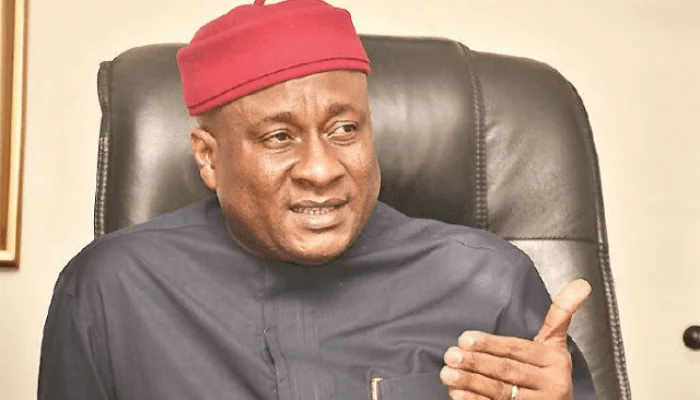
Allen Onyema, chairman of Air Peace, has warned that airlines may suspend operations across Nigeria within seven days if aviation fuel prices are not reduced.
Speaking to journalists after a stakeholders’ meeting with regulators and the minister of aviation, Festus Keyamo, Onyema said the rising cost of jet fuel has become unsustainable for operators.
He said airlines are struggling to cope with the sharp increase in prices, stressing that continued operations under current conditions may no longer be viable.
“Why are we here in the first place?” Onyema said. “Since the advent of the U.S.-Iran war, there has been a tremendous spike in the cost of aviation fuel in Nigeria, which we feel is not proportionate to the rise in crude oil prices internationally.”
According to him, aviation fuel prices in Nigeria have risen far beyond global trends.
“We discovered that it’s only in Nigeria that we have about 250 to 270 percent increase, while in other parts of the world, including African countries, it’s about 70 percent,” he said.
The Nigerian Midstream and Downstream Petroleum Regulatory Authority (NMDPRA) said its nationwide price survey conducted on April 17, 2026, showed that aviation fuel prices ranged from N1,960 per litre to N2,800 per litre, depending on location and logistics.
FINDING SOLUTION
Onyema said the meeting with government officials and fuel marketers was convened to address the situation and find a lasting solution.
He said both airlines and marketers presented their concerns and agreed to allow regulators to review the issues.
“We’ve deliberated very hotly today. They shared their pain points, and we shared ours,” he said.
He added that airlines are now waiting for the outcome of further discussions between marketers and regulators.
“We expect that in the next 48 hours something drastic will be done,” he said.
Onyema warned that failure to act quickly could force airlines to halt operations.
“No airline in this country will fly in the next seven days if something is not done,” he said.
He explained that the threat is not intentional but driven by economic reality.
“Not because they don’t want to fly, but because the pricing of the fuel we need may not be sustainable. We don’t have the money, borrowed at 30 to 35 percent interest, to continue paying only fuel marketers,” he said.
Despite the concerns, Onyema expressed optimism that the government will intervene.
“The good news is that the president is listening,” he said. “This is very encouraging to us airlines.”
He added that President Bola Tinubu showed commitment during the engagement by immediately reaching out to the aviation minister.
“We are hopeful that at the end of the day there will be a consensus that will help everyone — the marketers, the airlines, and the Nigerian flying public,” he said.

