
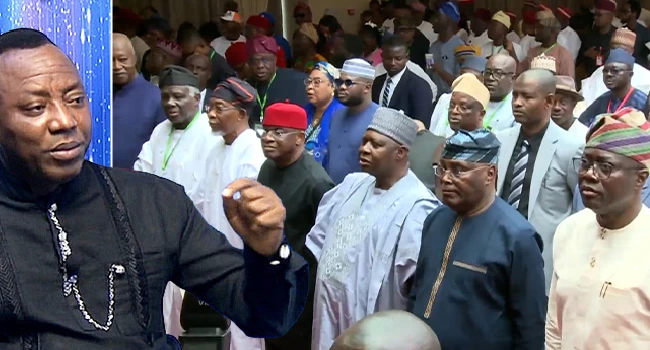
Human rights activist and former presidential candidate Omoyele Sowore has rejected participation in a recent opposition summit held in Ibadan, criticizing the gathering as an attempt to recycle discredited political figures ahead of the 2027 general elections.
In a statement shared on his X account, formerly known as Twitter, Sowore revealed that he declined an invitation to attend the meeting. According to him, many of the politicians involved do not have the credibility to present a genuine alternative to Nigerians.
“There is no need to pretend that the same people who presided over corruption, stagnation, and systemic decay can suddenly become champions of progress,” he wrote. “Not all Nigerians are suffering from amnesia.”
AAC Distances Itself from Opposition Coalition
Furthermore, Sowore made it clear that his party, the African Action Congress, would not participate in what he described as a political “charade.”
“Our revolutionary party will not join any effort designed to repackage failed political actors under the guise of opposition,” he stated. “Instead, we are focused on building a people-driven alternative rooted in integrity, accountability, and real transformation.”
In addition, Sowore criticized several major political parties, including the All Progressives Congress, Peoples Democratic Party, Labour Party, and African Democratic Congress. He argued that these parties have all contributed to Nigeria’s long-standing political and governance problems.
“Nigeria does not need a rearrangement of the same broken pieces,” Sowore added. “Rather, it needs a complete break from the past.”
Opposition Leaders Push for Unity Ahead of 2027
Meanwhile, opposition leaders from different political parties gathered in Ibadan for a national summit aimed at strengthening collaboration ahead of the 2027 elections.
The event, themed “Safeguarding Nigeria’s Democracy: A National Dialogue,” ended with participants agreeing to work toward forming a united opposition front. Discussions also included the possibility of presenting a single presidential candidate to challenge President Bola Tinubu in 2027.
Moreover, a joint communiqué known as the Ibadan Declaration warned that Nigeria’s democracy is facing increasing pressure. Participants expressed concerns over the concentration of political power and the growing fear of a one-party state.
Key Political Figures Attend Summit
Several prominent political figures attended the summit, including Atiku Abubakar, Peter Obi, Rabiu Kwankwaso, and Rotimi Amaechi.
During the discussions, speakers such as Seyi Makinde emphasized the importance of a strong opposition in preserving democratic governance. Similarly, figures like David Mark and Taminu Turaki described the coalition effort as an important step toward national recovery.
Electoral Reform Demands Take Center Stage
At the same time, participants raised concerns about the credibility of Nigeria’s electoral system. As a result, the summit passed a vote of no confidence in Joash Amupitan, identified as chairman of the Independent National Electoral Commission committee referenced at the meeting, over allegations of bias.
The summit also called for several electoral reforms, including:
- Extending deadlines for party primaries
- Promoting greater inclusivity in the political process
- Protecting fundamental human rights
- Releasing political detainees
What the Developments Mean for Nigeria
Although opposition leaders are working toward a united front for the 2027 elections, Sowore’s rejection of the coalition highlights the deep divisions that still exist within Nigeria’s political landscape.
Consequently, political observers believe the success of any opposition alliance may depend on its ability to overcome internal disagreements and convince Nigerians that it represents genuine change rather than a rebranding of familiar political actors.

