
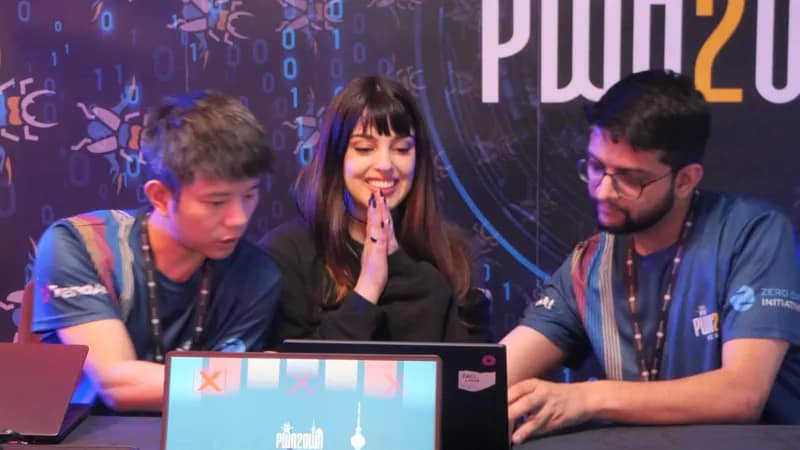
Champion Hacker Raises Concerns Over Advanced AI Tools
Award-winning ethical hacker Valentina Palmiotti has warned that advanced artificial intelligence tools could soon outperform human hackers in major cybersecurity competitions.
Palmiotti, widely known in the hacking community as Chompie, made the remarks after emerging as the most successful individual competitor at the annual Pwn2Own contest in Berlin.
She said powerful AI systems such as Claude Mythos and GPT 5.5 Cyber could eventually reduce the need for many professional vulnerability researchers.
AI Tools Already Transforming Ethical Hacking
According to Chompie, AI currently serves as a valuable assistant for ethical hackers and security researchers.
She explained that tools like Claude Code help researchers test vulnerabilities faster and improve workflow efficiency.
The cybersecurity expert added that AI has become useful both in competitions and in her role at IBM X-Force.
However, she warned that the balance may soon change.
“I competed in Pwn2Own this year because I thought it might be my last chance,” she said.
She noted that AI could soon eliminate many simpler vulnerabilities, leaving only highly complex security flaws for elite researchers to discover.
Pwn2Own Rewards Hackers for Finding Vulnerabilities
The Pwn2Own contest invites ethical hackers from around the world to identify software vulnerabilities before cybercriminals exploit them.
Organisers awarded nearly $1.3 million to participants this year after competitors uncovered dozens of new hacking methods.
Companies later receive the findings and fix the security weaknesses before attackers can exploit them.
During the competition, Chompie successfully hacked a system connected to Nvidia and earned $20,000.
She later spent an entire night preparing for another challenge before winning an additional $50,000 after breaching a Linux-based system.
Hackers Enter ‘Zombie Mode’ During Competitions
Chompie described her intense preparation process as “zombie hacker mode.”
She said the routine often involves hours of nonstop testing, energy drinks, and little sleep.
The cybersecurity researcher explained that many competitors now rely heavily on AI support during these demanding sessions.
Despite her concerns, some hackers remain optimistic about the future of human-led cybersecurity research.
Human Creativity Still Matters, Experts Say
Another leading competitor, Orange Tsai, argued that AI still lacks the creativity and intuition of experienced researchers.
Tsai led his team to win $375,000 after uncovering complex hacking pathways during the Berlin competition.
“For me, AI feels more like a really awesome assistant that helps accelerate my research workflow,” he said.
He acknowledged that AI continues to raise standards in cybersecurity but believes human experts will still uncover vulnerabilities that machines may overlook.
AI Raises New Cybersecurity Concerns
The rapid growth of AI-powered cybersecurity tools has sparked wider concerns within the tech industry.
Anthropic, the developer behind Claude Mythos, reportedly claimed the system identified over 1,600 software vulnerabilities across hundreds of programmes.
Because of its capabilities, access to the model reportedly remains restricted to selected governments and cybersecurity institutions.
Experts also fear that cybercriminals may increasingly use AI to launch faster and more sophisticated attacks.
However, many current cyberattacks still rely on phishing emails, fake links, and social engineering rather than advanced hacking techniques.
Ethical Hackers Call for Responsible AI Use
Chompie believes AI could eventually strengthen internet security if developers release such systems responsibly.
She argued that ethical hackers and cybersecurity defenders should gain access to advanced AI tools before criminals do.
According to her, stronger defensive systems could eventually make cyberattacks more difficult across the internet.
“The good guys need the most powerful tools first,” she said.

