

The Super Eagles missed the men’s World Cup. The Super Falcons have now missed the women’s. And nobody in authority seems sufficiently embarrassed.
There is a phrase Nigerians use when something has gone comprehensively wrong: “e don do.” It is enough. It is too much. There is nothing left to salvage from the wreckage.
That phrase now applies to Nigerian football in 2026 with a completeness that is almost difficult to process.
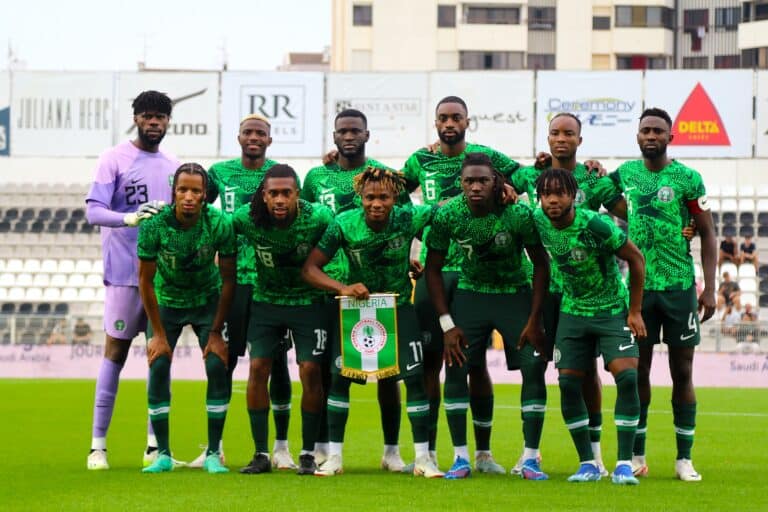
The Super Eagles did not play at this year’s men’s World Cup, eliminated by DR Congo in a playoff final that exposed every structural weakness the Nigeria Football Federation has been papering over for years. While thirty-two nations competed in the United States, Mexico, and Canada, Nigeria watched.
Now, for the first time in the history of the competition, the Super Falcons have failed to qualify for the FIFA Women’s World Cup, their unbroken record of appearing at every edition since 1991 finally broken by a 2-1 defeat to South Africa in Casablanca.
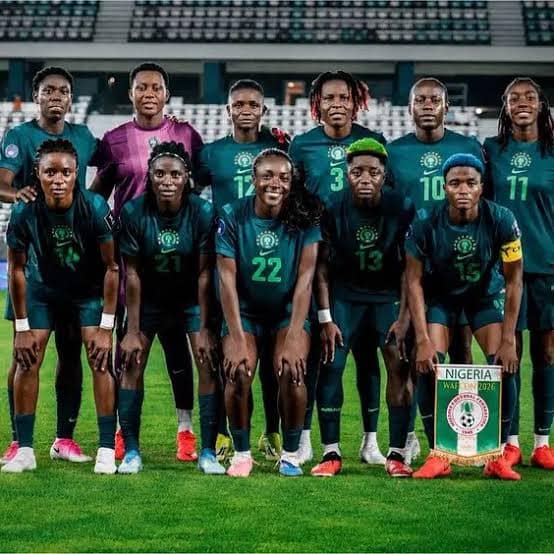
Ten-time African champions. Absent. Not because they lacked talent. Because they lacked everything around the talent that makes talent matter. South Africa found the breakthrough in the 56th minute through Thembi Kgatlana, before Refiloe Jane doubled the lead in the 77th minute. Nigeria found a lifeline deep into stoppage time when Christy Ucheibe converted a penalty in the 90th minute, but South African goalkeeper Kaylin Swart made the save that mattered most on the final play of the match, preserving the 2-1 victory.
A goalkeeper who had suffered a heavy collision earlier and nearly left the field ended Nigeria’s 35-year World Cup record. That detail, more than any other, captures how thin the margin was. And how unforgivable the path that led to it.
The Root
Because this defeat did not begin in Casablanca. It began years ago in the boardrooms of Nigerian football administration. In the appointment of coaches who were never given adequate preparation time. In the chronic underfunding of domestic women’s football. In the failure to develop a pipeline of players that does not depend entirely on a handful of diaspora-based stars carrying the full weight of a nation’s ambitions on rotation.
The Super Falcons went to WAFCON 2026 as defending champions and ten-time winners of the continent’s premier women’s competition. They lost to Cameroon in the quarter-finals. A side that failed to qualify for the last WAFCON edition and only entered this one through an expanded field based on world ranking became African champions. Then South Africa, armed with organisation and tactical discipline, ended Nigeria’s World Cup story in a playoff.
Not Coincidental
The pattern between the men’s and women’s situations is not coincidental. It is systemic. The same federation that has consistently prioritised politics over merit in its appointments, the same government sports ministry that releases funds inconsistently and without accountability, the same culture of entitlement that assumes that being Nigeria is enough to guarantee results; all of this runs through both failures equally.
Nigerian football does not have a talent problem. Drive through any city in this country on a weekend morning and you will see football being played. Whether it is on concrete and in sand, it is played with a commitment that no amount of money can manufacture. The raw material has never been the issue.
What Nigerian football has is a governance problem. A structural problem. A problem of institutions that exist to serve the people inside them rather than the players who represent the nation.
Two World Cups. One year. Two absences that would have been unthinkable years ago.
The NFF has issued a statement. There has been calls for the coach’s head. A review will be announced. And then, quietly, everything will return to exactly the way it was before. A cycle that has gradually become the new identity of the nation’s football. Unless Nigerians decide that this time, enough is enough.
The green and white jersey deserves better than this. The players who wear it deserve better. And so do the millions of Nigerians who still care enough to watch, hope, and feel this kind of pain.

