
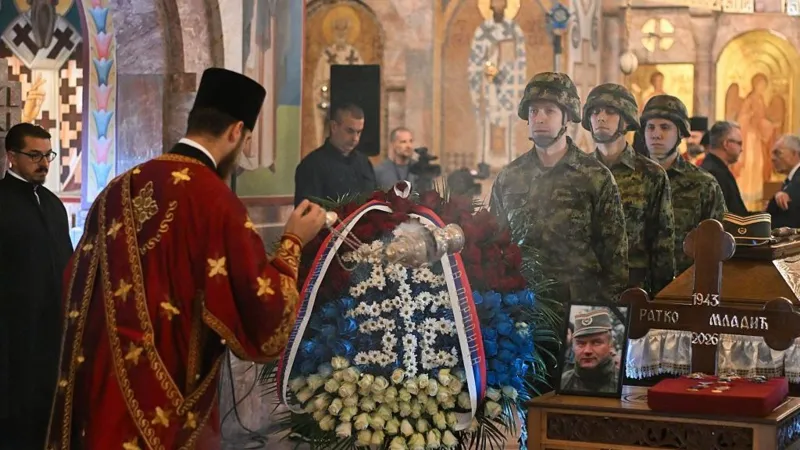
Thousands of people gathered in Belgrade on Monday for the funeral of convicted Bosnian Serb war criminal Ratko Mladić, whose public honours have drawn strong criticism from the European Union.
Mladić died in late August at the age of 84 while serving a life sentence in The Hague for genocide, war crimes and crimes against humanity committed during the Bosnian War.
He was convicted over his role in the 1995 Srebrenica massacre, in which around 8,000 Bosniak Muslim men and boys were killed. The atrocity is widely regarded as Europe’s worst massacre since the Second World War. Mladić also commanded Bosnian Serb forces during the siege of Sarajevo and the wider campaign of ethnic cleansing against Bosniak and Croat populations during the 1992–1995 war.
His coffin was placed on public display at St Luka Church in Belgrade before the funeral service. Large crowds, including war veterans and supporters, gathered outside the church. Some mourners carried Serbian flags and images of Mladić, while others lit candles and waited in long queues to pay their respects.
Several Serbian government ministers attended the ceremony, despite earlier assurances that serving officials would not participate in formal honours. The service was led by Serbian Orthodox Patriarch Porfirije.
The Serbian government had initially announced military and state honours for Mladić. President Aleksandar Vučić later rejected suggestions that the event amounted to an official state funeral. Further saying the arrangements reflected the wishes of the family.

European Union’s Disapproval
The European Union has strongly condemned what it described as the glorification of a convicted war criminal.
“Any glorification of war criminals, genocide denial and revisionism contradict the most fundamental European values,” an EU spokesperson said.
The bloc added that such actions have no place in EU member states or candidate countries. Serbia has been an EU candidate since 2012, while its accession process has stalled in recent years. EU Enlargement Commissioner Marta Kos also cancelled a planned visit to Serbia following the controversy surrounding Mladić’s return.
Mladić was arrested in Serbia in 2011, 16 years after he was first indicted by the UN tribunal. He was convicted in 2017 and sentenced to life imprisonment, with his conviction and sentence upheld on appeal in 2021.
Despite the convictions, Mladić remains a revered figure among some Serbian nationalists, particularly in Republika Srpska.
READ ALSO: https://alo360.net/hafidh-ameir-hassan-dies-tanzania-president-husband/

