
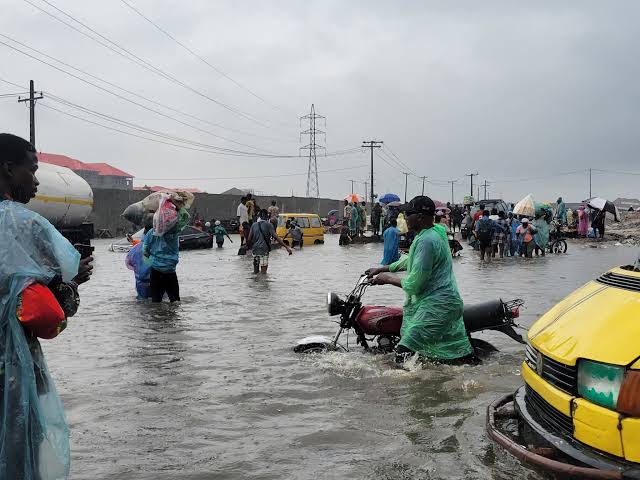
Every rainy season, Lagos drowns. And every year, the reasons are exactly the same.
On the morning of June 29, 2026, Lagos residents woke up to streets that had become rivers overnight. From Gbagada to Lekki, Surulere to Ikorodu, Oshodi to Chevron, water swallowed roads, entered homes, and swallowed vehicles whole. Motorists abandoned cars on flooded expressways. Some residents navigated their neighbourhoods by boat and makeshift canoe. This is Lagos in the rainy season. This is Lagos resigned to its fate every rainy season.
Lagos tops the list of 33 states expected to experience severe flooding in 2026, according to federal government projections. The National Inland Waterways Authority, NiMet, NIHSA, and NEMA jointly flagged July to September as the period of greatest vulnerability. We are in that window now. And the city is already underwater before the worst has even arrived.
The Numbers Behind the Crisis

In 2025, 57,951 Lagos residents were affected by flooding, with 3,680 displaced. NEMA recorded 241 deaths, 839 injuries, and 433,578 people affected across 27 states by November of that year, with 52,509 houses destroyed or damaged.
The flooding episodes of 2024 and 2025 combined destroyed houses, infrastructure, agriculture, and small businesses to a total estimated loss of N13 trillion across affected states. That is not a weather report. That is a governance bill.
NiMet’s 2026 seasonal climate prediction projects an elongated rainy season with a delayed end, with projected annual rainfall reaching up to 2,010mm in Badagry and averaging around 1,965mm across Lagos’s 20 local government areas. The peak has not yet arrived.
Why Lagos Keeps Flooding

The explanation is not complicated. It is simply inconvenient for those responsible.
Lagos faces increasing flood risk due to its low-lying coastal setting combined with sea-level rise, more intense rainfall, land subsidence, and rapid, poorly regulated urbanisation. Groundwater over-extraction, loss of wetlands, inadequate and clogged drainage, unstructured land reclamation, and major infrastructure projects further reduce natural water absorption, amplifying flood frequency and severity.
Many drains are clogged with plastic waste, sand, construction debris, and household refuse. When heavy rain begins, the water has nowhere to flow, forcing it onto roads and into residential areas.
Residents across Surulere, Agege, Lekki, and Mafoluku describe recurring floods that trap people indoors, damage homes and businesses, and disrupt movement whenever heavy rainfall occurs.
One Surulere resident put it plainly: “Once the rain starts, our streets disappear beneath water. If I must leave home, my long rain boots become my only option.”
That is not a quote from 2010. That is July 2026.
The Warnings Were There

Weeks before the heavy rainfall, both LASEMA and NEMA intensified flood preparedness campaigns across the state, warning residents that the 2026 rainy season could bring severe flooding if preventive measures were ignored.
LASEMA Permanent Secretary Dr. Olufemi Oke-Osanyintolu said Lagos was shifting “from a reactive to a responsive approach” to disaster management, adding that “response alone is no longer sufficient.”
The warnings came. The floods came anyway.
Between 2025 and early 2026 alone, over N106 billion was committed to drainage construction, dredging, and rehabilitation projects across Lagos. Over 12 percent of Lagos’s land area falls within high-risk flood zones. The money went in (if it really did). The water still comes.
The question is not whether the government is spending. The question is whether the spending is reaching the right places or whether it is disappearing into the same system that allowed streets in Lekki and Surulere to become canals in 2026 just as they did in 2016, in 2011, and in every year in between.
The People Bearing the Cost
Children are the most affected demographic in Nigerian flooding. NEMA’s data showed that flooding affected 197,566 children nationally in 2025 alone, compared to 82,820 men and 133,407 women.
Behind every statistic is a family that lost something it cannot get back. A shop owner in Mafoluku watching stock float away. A mother in Gbagada carrying a child through knee-deep water to reach a school that will likely be closed anyway. A landlord in Ikorodu watching walls crack under the weight of water that should have drained hours ago.
Floods in Lagos increase the risk of waterborne diseases such as cholera and typhoid fever, which spread rapidly in crowded urban areas. We have already written about cholera in Nigeria this year. We have already written about hunger. Now flooding arrives to compound both, damaging farmland and contaminating water sources in the same season.
New Year. Same Story.
Lagos is Africa’s largest city. It is Nigeria’s economic engine. It is home to over 22 million people. And every single year, without fail, significant portions of it flood in ways that other megacities with competent urban management do not.
The rain is not new. The flooding is not new. The displacement, the deaths, the destroyed businesses, the contaminated water, and the children wading to school are not new.
What remains stubbornly, persistently new is the surprise with which authorities greet it each time — the press releases, the sensitisation campaigns, the promises of dredging and drainage expansion that somehow never quite reach the streets that flood most reliably, most annually, most devastatingly.
Lagos does not have a flooding problem. It has a priorities problem. And until the people making decisions about this city begin to treat flood management with the urgency of someone whose home is actually at risk of going underwater, the story next July will read exactly like this one.
Mainland? Island? The floods take no prisoners by class or status.

