
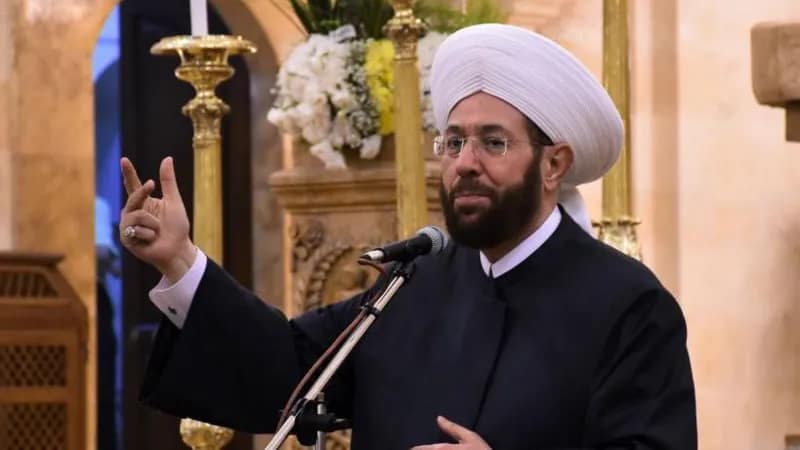
A Syrian court has sentenced the country’s former top Muslim cleric to life in prison after finding him guilty of crimes. This includes inciting civil war and complicity in intentional killing during the rule of ousted President Bashar al-Assad.
Ahmed Hassoun (77) served as Syria’s grand mufti from 2005 to 2021 and was one of the most prominent religious figures under Assad’s government.
The Fourth Criminal Court in Damascus ruled that the official religious establishment led by Hassoun had been used to provide religious justification for the regime’s military and security operations during the country’s devastating civil war.
According to Syria’s state news agency Sana, the court found that the mufti’s office had helped provide public and religious cover for military actions. This included the use of barrel bombs against populated areas. However, Hassoun denied the charges.
The Genesis
The court’s ruling comes as Syria’s transitional authorities continue prosecuting senior figures linked to the former Assad regime. The conflict began in 2011 after Assad’s government violently suppressed a pro-democracy uprising. That crackdown developed into a civil war that killed more than 600,000 people and forced about 12 million others from their homes. Barrel bombs became one of the regime’s most notorious weapons during the conflict. The large improvised explosives were dropped from aircraft over rebel-held areas, often causing widespread destruction in populated communities.
One monitoring group estimates that nearly 82,000 barrel bombs were dropped between 2012 and 2021, killing more than 11,000 civilians.
Prosecutors accused Hassoun of using religious lectures, public meetings, media interviews and other public appearances to support the Assad government and encourage violence against civilians. They pointed in particular to an interview with Syrian television during the battle for Aleppo in 2015.
In the interview, Hassoun called on civilians to leave rebel-held eastern Aleppo and said areas from which shells were fired should be completely destroyed. The court also found that Hassoun had received money and gifts in exchange for intervening in cases involving civilians detained by security agencies.
Sana further reported that he regularly provided financial support to Liwa al-Quds, a pro-Assad militia. Hassoun told the court that some video footage used against him had been taken out of context. He maintained that he had attempted to save people from the former regime rather than support its abuses.
Despite that defence, the court convicted him on multiple counts. Hassoun was sentenced to life imprisonment for inciting civil war and sectarian strife. He also received a 20-year sentence for incitement to intentional killing, 10 years for principal participation in intentional killing and three years for abuse of office. He is the 10th Assad-era figure to be sentenced by Syria’s transitional authorities.
Earlier Convictions
Earlier this month, Assad, his brother Maher and seven other senior figures from his former government were convicted in absentia of crimes against humanity. They were also sentenced to death by the same court. The only defendant in that case who was tried in person was Atef Najib, an Assad cousin and former head of Political Security intelligence in Deraa. Another Assad cousin, Wassim Assad, was later sentenced to death after being convicted in person of crimes including murder.
The prosecutions have offered some Syrians a sense of accountability after years of frustration over the lack of punishment for alleged crimes committed during the civil war. However, human rights activists have also called for greater transparency over the trials and the process through which the verdicts were reached.
The court’s action comes at a significant moment for Syria’s new government. The United States has also moved to ease Syria’s international isolation. By removing the country from its list of state sponsors of terrorism after 47 years.
Washington has also lifted the terrorist designation against Hayat Tahrir al-Sham (HTS), the Islamist group led by interim President Ahmed al-Sharaa that played a central role in overthrowing Assad. HTS, formerly known as al-Nusra Front, was previously affiliated with al-Qaeda before Sharaa severed ties with the jihadist organisation in 2016.
The US says the sanctions relief is intended to encourage investment and promote political and economic stability. Especially as Syria begins its transition after Assad’s rule.
READ ALSO: https://alo360.net/burnham-support-ukraine-russian-threats/

