
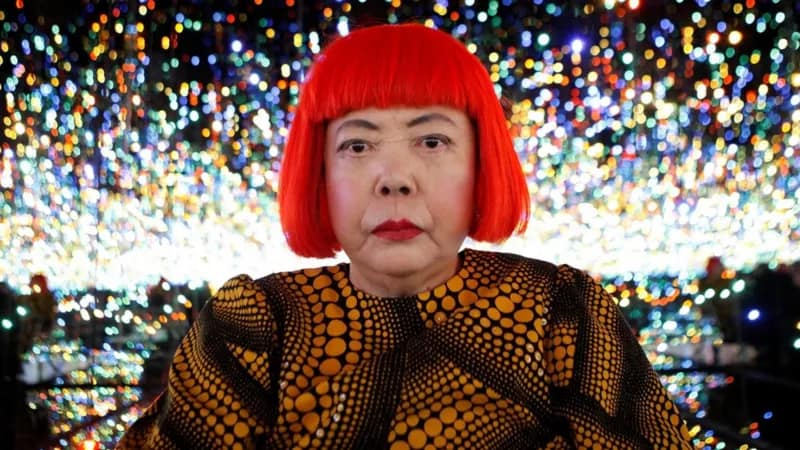
Japanese avant-garde artist Yayoi Kusama, one of the world’s most recognisable contemporary artists, has died at the age of 97.
Kusama’s company confirmed that the artist died at a hospital in Tokyo on August 14, 2026, describing her death as a moment of “profound sorrow.”
Throughout her extraordinary career, Kusama worked across visual art, sculpture, installations, performance, fiction and poetry. Although she was largely overlooked for much of her early career, she eventually became a global cultural icon, particularly in her 80s and 90s. Her distinctive artistic identity was marked by bold polka dots, pumpkins, mirrors, bright colours and immersive installations. She was also widely recognised for her bright-red wig and colourful polka-dot clothing.
From Japan to New York
Born in 1929 in Matsumoto, in Japan’s Nagano region, Kusama developed an interest in painting at an early age despite opposition from her conservative family. She eventually travelled to the United States and became involved in New York’s avant-garde art scene during the 1960s.
Her work challenged conventions and frequently incorporated provocative themes. She staged exhibitions featuring phallic sculptures and displays of nudity, attracting both attention and criticism in a male-dominated art world.
Kusama later expressed frustration that some of her ideas appeared to be adopted by male contemporaries, whose work often received greater recognition from major galleries. Feeling increasingly disillusioned, she eventually returned to Japan.
Art Became a Way of Understanding Her Experiences
Kusama had experienced hallucinations since childhood, including visions of patterns spreading across surfaces and objects. She later transformed these experiences into her art, using repetition, dots, mirrors and infinity-themed installations to recreate aspects of the world as she perceived it.
In her autobiography, she recalled seeing a red flower pattern on a tablecloth and then experiencing the same pattern covering the ceiling, windows, pillars and her own body.
After returning to Japan, Kusama voluntarily entered a psychiatric hospital, where she continued to live and work for decades. The hospital provided a secure environment in which she could continue creating art, with doctors who were interested in art therapy.
The Rise of The Infinity Mirror Rooms
One of Kusama’s most famous creations was her Infinity Mirror Rooms, immersive installations that use mirrors and lights to create the illusion of endless space. The works became hugely popular and eventually attracted millions of visitors.
Her distinctive polka-dot artworks and sculptures also became highly sought-after, transforming Kusama from an underappreciated avant-garde artist into one of the most commercially successful and recognisable figures in contemporary art.
In 1993, she became the first Japanese woman to represent Japan as a solo artist at the Venice Biennale. The success of the exhibition marked a major turning point in her international reputation. Her works subsequently appeared in major museums and exhibitions around the world.
From Overlooked Artist to Global Icon
Kusama’s reputation grew dramatically in her later years. Social media played a major role in introducing her work to new audiences, with her colourful installations, floral sculptures and reflective artworks becoming popular backdrops for photographs.
Her art also extended beyond traditional galleries. She collaborated with major luxury brands, including Louis Vuitton, further cementing her status as a global cultural icon.
One of her paintings sold for approximately $10.5 million at auction in 2022. Despite the commercial success, Kusama continued to work throughout her later life. Her company said she continued painting until her final days. She also remained committed to exploring themes including “forever love and eternal soul.”
Among Kusama’s many recurring motifs, the pumpkin became particularly associated with her work. For Kusama, pumpkins represented comfort, stability and nostalgia. “Pumpkins speak to me,” she once said, explaining that they gave her a sense of peace.
One of her most famous pumpkin sculptures is the Red Pumpkin on Naoshima, an island known for its contemporary art installations. Visitors arriving by ferry can see the large red sculpture covered in black polka dots.
Kusama’s legacy now extends far beyond Japan. Her work helped redefine the possibilities of contemporary installation art while bringing her intensely personal experiences to audiences around the world.
Her death closes the extraordinary life of an artist whose greatest recognition came decades after she first began challenging the boundaries of art.
READ ALSO: https://alo360.net/russian-chess-official-dies-after-reported-malaria-infection-in-nigeria/

