
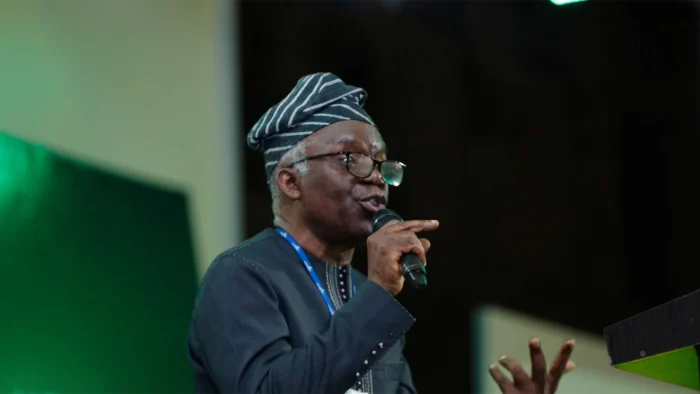
Human rights lawyer, Femi Falana (SAN), and pro-democracy activist, Ayo Obe, have urged religious bodies to play a stronger role in protecting democracy and citizens’ rights ahead of the 2027 general elections.
They made the call at Bishop Mike Okonkwo’s annual birthday lecture in Lagos on Thursday. The event, held at the Muson Centre, focused on electoral credibility, judicial integrity and Nigeria’s democratic future.
Falana asks churches to monitor government spending
Falana, who chaired the event, said religious institutions must look beyond spiritual matters and pay closer attention to governance. He urged churches to examine government budgets at the federal, state and local government levels. He also asked them to monitor how authorities spend public funds.
According to Falana, religious institutions cannot remain passive when government decisions affect the lives and welfare of their members. He also called for human rights bodies within churches to monitor violations against members and other Nigerians.
Falana said democracy involves more than holding elections. In his view, accountable leadership, effective public service, citizens’ welfare and security also form key parts of a democratic society.
The Senior Advocate of Nigeria said Nigeria faced serious concerns ahead of the 2027 elections. He listed political violence, disputed party primaries, electoral credibility and judicial integrity among the major issues. He stressed that citizens must participate in elections freely and peacefully, without intimidation or threats.
Falana seeks INEC autonomy
Falana expressed concern about the outcome of election disputes taken before tribunals and courts.
He said many election petitions fail because petitioners cannot prove alleged electoral malpractice. He also said some cases face dismissal on technical grounds.
According to him, such outcomes could encourage politicians who manipulate elections because opponents may struggle to obtain judicial redress.
Falana cited the governorship elections in Anambra and Ekiti states as examples of credible polls. He noted that losing candidates in both states did not challenge the results at the tribunals.
He also referred to the August 15, 2026, governorship election in Osun State. According to Falana, the All Progressives Congress accepted the result and congratulated the winner.
“The development confirms that if credible elections are conducted by the Independent National Electoral Commission (INEC), the electorate and not judges will determine the outcome of elections in Nigeria,” he said.
Falana consequently called for complete autonomy for INEC. He said the electoral commission must conduct elections without political interference.
Lawyer warns against electoral violence
Falana also raised concerns about threats of violence from political actors ahead of the 2027 elections. He urged authorities to prosecute individuals who make such threats. According to him, failing to punish political actors could encourage further violence during future elections.
The human rights lawyer recalled a former Head of State’s description of an election as a “do or die battle.” He said the election later became violent and resulted in several deaths.
Falana argued that the failure to prosecute those behind such threats could encourage similar conduct in the future. He also referred to comments by former Cross River State governor and 2027 Peoples Redemption Party presidential candidate, Donald Duke.
Falana said Duke had alleged that some Nigerian politicians resorted to human sacrifice in their pursuit of political power. He warned that the desperation for political office could threaten the country’s peace.
The Senior Advocate also called on the government to stop the killing of unarmed citizens by terrorists, kidnappers, armed robbers and other gunmen. He further urged the police and anti-corruption agencies to intensify their efforts against vote buying.
Falana said money used to induce voters should instead fund poverty reduction programmes. He argued that democracy should improve citizens’ living conditions rather than end with the conduct of elections.
Obe raises concerns over electoral process
Ayo Obe said Nigerians should not assess electoral credibility only by what happens on election day.
She acknowledged that technologies such as the Bimodal Voter Accreditation System and INEC Election Results Viewing Portal had improved vote counting.
However, Obe identified several factors that could weaken participation and public confidence. These include voter registration manipulation, insecurity, violence, intimidation and vote buying. She also expressed concerns about provisions in the 2026 Electoral Act.
According to Obe, the law gives INEC greater powers while seeking to limit court jurisdiction over internal party disputes. She also raised concerns about the costs involved in pursuing election petitions.
Obe said INEC’s power to recognise factions within political parties places a significant responsibility on the commission. She noted that the exercise of such powers had not always escaped concerns about political interests.
On judicial integrity, Obe said the issue goes beyond corruption. She argued that an effective judiciary must demonstrate independence, impartiality, competence, courage and transparency. It must also retain public confidence, she added.
The speakers urged religious institutions and other stakeholders to become more involved in defending democratic values and protecting citizens’ rights as Nigeria approaches the 2027 elections.

