
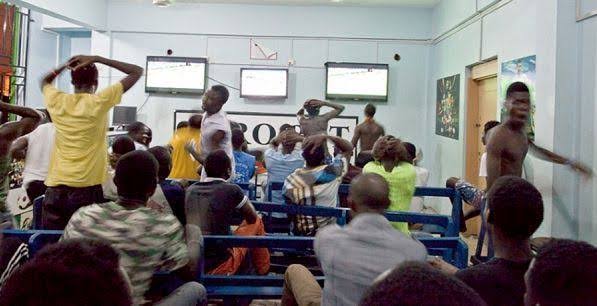
Gone are the days when indulging in sports betting meant queuing at the sparsely existing betting shops, most of the time for a lengthy period. The days when kids could not participate in such an activity are gone. Today, we have a different story on our hands, one that is littered with issues that are being ignored.
Nigeria has over 60 million active bettors today, which is a good portion of the nation’s population. Why the sudden boom? Why has everyone been thrown into a frenzy? One word: Digitalisation.
Improved devices and internet access placed in the hands of the bookies a gold mine. With the lengthy queues eliminated, Vegas was now brought to customers in the comfort of their homes.

While the Gambling spike in Nigeria can be largely attributed to national issues such as poverty and unemployment, it still remains an attack on the nation’s youth population. Now more than ever, we have younger folks trapped in the money-chasing thrill of gambling.
Addictions, financial irresponsibility, and depression, among others, are a few of the side effects on individuals.
Gambling, just like any business, is designed for the service provider to make profits. In other words, it is not designed to make its customers rich. It is designed to encourage customers to keep returning in the hope of recouping losses or finding rare luck.
How We Can Protect Our Youth
The answer begins with honesty. Nigeria cannot protect its youth from gambling while simultaneously treating the industry as a revenue stream to be celebrated rather than regulated.

Nigeria’s online sports betting market is projected to grow to $402 million by 2029. You cannot collect taxes from an industry with one hand and protect children from it with the other. One of those hands has to let go.
A 2025 study of Nigerian undergraduates found that nearly half of all students who bet in the previous year met the clinical criteria for problem gambling, with sports betting strongly associated with academic difficulties. These are not idle young men on street corners. These are students in universities, sitting in lecture halls with betting apps open on their phones, chasing losses between classes.
Research has consistently identified the ubiquity of sports betting advertisements, peer pressure, and the proliferation of bet shops as the primary drivers pulling Nigerian youth into gambling. Every billboard, every celebrity endorsement, every “bet and win” advertisement running during a football match is a recruitment message aimed at the youngest, most impressionable segment of the viewing audience.
What protection looks like in practice is not complicated, but it requires political will that has so far been absent.
Advertising regulation must be enforced with teeth. Betting companies should not be permitted to use football stars, musicians, or cultural influencers to market gambling products to an audience that is overwhelmingly young and financially vulnerable. The current regulatory framework under the National Lottery Regulatory Commission is insufficient, underfunded, and routinely bypassed.
Age verification on betting platforms must become mandatory and monitored rather than a checkbox exercise. Research shows that 87.2 percent of Nigerian students engaged in gambling are male, with the majority gambling because they needed money.
Mental health support for gambling addiction must be integrated into Nigeria’s public health framework. The mental health consequences of gambling addiction include depression, anxiety, and in documented cases across Africa, suicidal thoughts. Nigeria’s mental health infrastructure is already strained. Adding an unaddressed gambling addiction crisis to it without resources is a disaster building quietly in plain sight.
Finally, and most fundamentally, the government must address what is driving young Nigerians to gambling in the first place. Unemployment and poverty remain the primary structural forces pushing Nigerian youth toward betting as an economic survival strategy. A young man with a job, a skill, and a dignified livelihood does not need a betting slip to feel like he has a future.
The Nation Is Watching With Arms Folded
Nigeria has a generation of young people who are bright, resourceful, and desperate. Desperate for money in an economy that has failed them. Desperate for excitement in a society that has offered them very little to look forward to. Also desperate for the one big win that will change everything.
However, the betting industry met that desperation with an app, a bonus offer, and a promise. The promise, as we have established, is a lie. Gambling is not designed to make its customers rich. It never was. It was designed to keep them coming back. And in Nigeria, with 60 million active bettors and an industry growing at nearly seven percent annually, it is working exactly as designed.
What is not working is the response. Not from government. Not from schools. Neither from families who have watched sons and daughters disappear into screens and return hollow. Nor from a society that has somehow decided that a young man losing his school fees on a football accumulator is a personal problem rather than a national emergency.
The sickness is real. It has a name. Nigeria must decide, before this generation is entirely lost to it, whether it will treat gambling addiction as the public crisis it is, or continue to treat it as background noise in a country already loud with problems it refuses to solve.
The youth are not asking to be saved from themselves. They are asking to be given something worth more than a betting slip to believe in.
READ ALSO: https://alo360.net/lagos-floods-2026-causes-governance-failure/

